
Happiness Environment: How to Create a Positive Environment
Marcus never thought of himself as particularly unhappy, but he wasn’t particularly joyful either. He was a 37-year-old accountant living in suburban Denver, going through the motions. Then his daughter asked him a simple question at dinner one Tuesday: “Dad, when was the last time you laughed really hard?” Marcus couldn’t remember. That night, unable to sleep, he decided something had to change. He started small, reorganizing his home office to face the window instead of the wall, joining his neighbors for their weekly walking group, and finally decluttering the garage that had stressed him out for years. Within months, Marcus had transformed his happiness environment entirely. He switched to a job closer to home, created a weekly game night tradition with friends, and even convinced his workplace to start “walking meetings.” Marcus didn’t just decide to be happier; he engineered his entire world to nudge him toward joy. His story illustrates a powerful truth: happiness isn’t just about positive thinking or good habits. It’s about creating a safe and happy environment that supports those habits automatically.
This week’s affirmation captures this wisdom perfectly: My environment promotes joy! When we learn how to create a positive environment across all areas of life (from our community and workplace to our social network, home, finances, and inner life), we set ourselves up for sustainable well-being. We’re not just building a happy environment in one area; we’re creating a happy environment across all aspects of living. We’re discovering how to be happy in life by creating systems that support joy. Moreover, we’re establishing a happy work environment that energizes rather than drains us. Finally, we’re creating a happy life by design, not by accident. Most importantly, we’re recognizing that our happiness environment is the foundation for everything else we’ve learned about joy.
“Your environment is the biggest, most important, and most impactful thing you can change to favor your health and happiness.” – Dan Buettner

The Blue Zones Approach to Environmental Happiness
Dan Buettner, the author of The Blue Zones and The Blue Zones of Happiness, thinks that trying to adopt the right healthy habits by simply relying on our own willpower may not be enough. He believes that we must create an environment around ourselves that will constantly nudge us into healthy and joy-boosting behaviors, such as exercising, socializing, eating better, sleeping more, meditating, etc. Buettner offers some great evidence-based ideas and strategies on how to shape your surroundings in ways that will raise your happiness levels in the long run.
Through his research on the world’s happiest places, Buettner identified three particularly joyful regions, each excelling in a different aspect of well-being. Denmark tops the charts for Purpose, as people there have strong social safety nets and trust in their institutions. Costa Rica shines in Pleasure, with its “pura vida” lifestyle emphasizing relationships, nature, and enjoying the present moment. Singapore excels in Pride, offering its citizens opportunities for achievement, financial security, and societal contribution. What makes these places special isn’t genetics or luck; it’s how their environments naturally promote happiness.
The Six Rings of Your Life Radius
Buettner and his team identified six critical areas that form your Life Radius: community, workplace, social network, home, finances, and inner life. Learning how to create a positive environment in each of these rings produces profound cumulative effects. Think of these rings as concentric circles of influence, each one affecting your daily experience and long-term well-being. The beauty of this approach is that you don’t need to overhaul everything at once. Small, strategic changes in each ring create a happy environment that supports you automatically, reducing the need for constant willpower and making joy the path of least resistance.
“Genuinely happy people do not just sit around being content. They make things happen. They pursue new understandings, seek new achievements, and control their thoughts and feelings.” – Dan Buettner
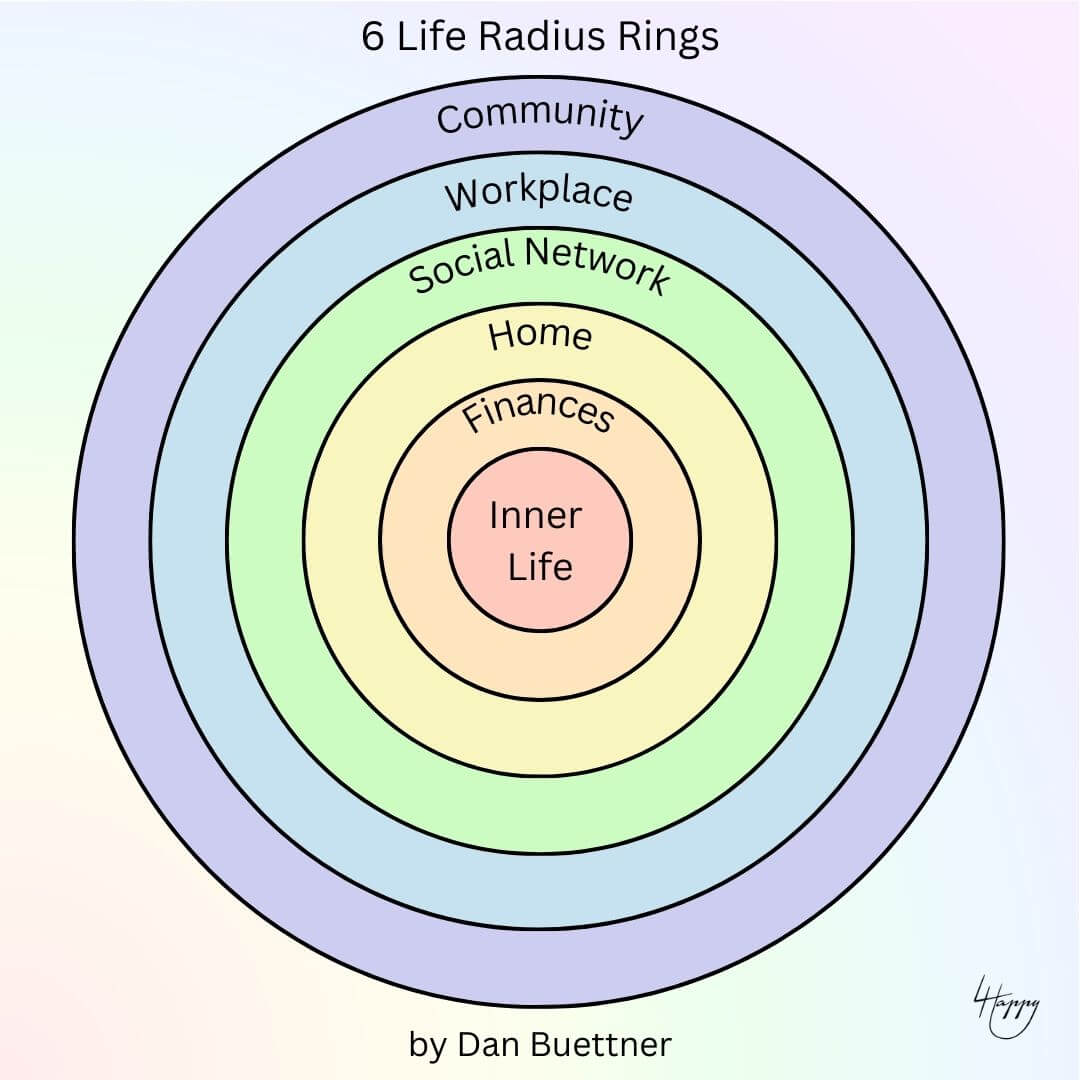
Community: The Foundation of a Safe and Happy Environment
Your community (the city, town, or neighborhood where you live) profoundly impacts your daily happiness. Studies reveal that when people move from countries where they fear for their safety and struggle to meet basic needs to places with peace, generosity, low corruption, quality healthcare, trustworthy politicians, and freedom to make decisions, they become significantly happier within just a few years. This transformation isn’t about genetics; it’s about creating a safe and happy environment.
An increasing number of scientists and politicians believe that, besides GDP, happiness should be one of the primary ways of measuring social progress. Bhutan pioneered this thinking with its Gross National Happiness Index, which assesses nine domains including psychological well-being, health, time use, education, cultural diversity, good governance, community vitality, ecological diversity, and living standards. The UK and other countries have since adopted similar approaches.
Building Your Happiness Environment at the Community Level
The Blue Zones Happiness Consensus Project brought together 18 of the world’s top happiness experts who identified ten policies governments can adopt to boost citizen well-being. These include promoting volunteering, measuring national well-being, focusing on the least happy through accessible mental health care, combating discrimination, allowing freedom in life decisions, investing in education and life skills teaching, supporting families, prioritizing preventive healthcare, and providing universal healthcare access.
But you don’t have to wait for policy changes. You can improve your community happiness environment today by voting for leaders who prioritize well-being and taking personal initiative. Consider promoting healthy lifestyles in your neighborhood, advocating for walking and biking infrastructure over car dependency, supporting limits on fast-food density, investing in green spaces and natural beauty, and creating committees focused on community well-being. If your current community doesn’t support creating a happy life, consider moving to a place with trustworthy leaders, high walkability, access to nature, strong civic engagement, clean air, affordable healthcare, and residents with healthy behaviors.

Workplace: Creating a Happy Work Environment
Your workplace dramatically impacts your overall happiness, consuming roughly one-third of your waking hours. When you create a happy work environment, you become more productive, creative, sociable, collaborative, engaged, and healthy, and you’re more likely to advance in your career. Building a happy work environment represents a crucial piece of your happiness environment puzzle.
Buettner studied the central market in Cartago, Costa Rica, and identified simple practices that raised both business outcomes and happiness levels. This “Cartago Code” includes greeting coworkers warmly, using friendly nicknames, shifting from competition to cooperation, creating friendship-based communities, joking frequently, and building mutual trust. These seemingly small practices transform any workplace into a happy work environment where people actually want to spend their time.
Designing Your Ideal Happy Work Environment
Creating a happy life through work means prioritizing purpose over paycheck. Find a job that gives you a strong sense of meaning – one where you use your talents and signature strengths, experience “flow,” and feel your work makes a real difference. Do something you genuinely love. If certain tasks at your current job bring you joy, find ways to do them more often. If not, consider changing jobs to better fit your interests and values.
Having an understanding, trustworthy, kind boss who’s open to new ideas and generous with compliments matters enormously for building a happy work environment. Leadership quality significantly affects whether you’ll have a happy work environment. Making friends at work transforms your daily experience. Get to know your colleagues and strengthen those connections. Consider working 40 hours weekly or less to maintain work-life balance, leaving time for loved ones and leisure. Find a job close to home, avoiding commutes longer than 30 minutes. If possible, walk or bike to work; this simple change significantly boosts well-being. Take walking breaks during the day, ideally with colleagues, combining socialization with movement.
Find meaning in your tasks. You’ll stay motivated when you feel your work is meaningful, when you’re praised, when you create things, when you face appropriate challenges, when you identify with your company’s mission, when you feel ownership, and when you’re proud of your contributions. Ensure you earn enough to meet basic needs with some left over for travel, entertainment, and treats. Avoid demotivation from repetitive, meaningless tasks or feeling ignored.

Social Network: The Heart of Creating a Happy Life
Strong social connections rank among the most powerful predictors of joy. Your social network (the people you spend time with regularly) shapes your happiness more than almost any other factor. When learning how to create a positive environment for well-being, designing an intentional social network is non-negotiable for creating a happy life.
The research findings are clear: people with strong social bonds live longer, experience less stress, recover faster from illness, and report higher life satisfaction. Your social network either lifts you up or drags you down. There’s little middle ground. This makes it one of the most important rings in your happiness environment.
Cultivating Relationships That Support Your Happiness Environment
Prioritize spending time with loved ones. Keep in touch with family and friends regularly, even when life gets busy. Socialize with people who make you feel happier and healthier. Prioritize happy friends with healthy habits over those who spread negativity. Remember that you must be a good, dependable, happy friend yourself. Relationships are reciprocal, and creating a happy life means being the kind of friend who contributes to others’ happiness environments, too.
Consider creating a “moai”, a circle of five to seven friends who commit to supporting each other long-term. This concept comes from Okinawa, one of the Blue Zones. These friends share values and interests, spend time together regularly through walks or healthy meals, support each other during troubles, and celebrate together during joys. A moai provides built-in accountability for maintaining a happy environment and creating a happy life together.
Join clubs to meet like-minded people who share your interests and values. This expands your social network naturally and enjoyably. Choose your romantic partner carefully, as this person typically has the biggest impact on your well-being. Find someone kind and compassionate who shares your values, interests, happiness levels, and sense of humor. Learn to listen with compassion and manage conflict constructively.
Regarding parenthood, Buettner advises realism. Children likely increase your sense of purpose but may not provide constant pleasure. Instead, they often add stress alongside meaning. This doesn’t mean avoiding parenthood, just entering it with clear eyes about its impact on your happiness environment.

Home: Your Safe and Happy Environment Base
Your home is your sanctuary, the place where you spend your non-working hours, where you rest and recharge. Designing a safe and happy environment at home is essential for sustainable well-being. Your home should actively support your happiness rather than drain it.
Clutter negatively impacts mood and self-esteem. Start by decluttering ruthlessly. Get rid of things you don’t need. Donate items to combine decluttering with the pleasure of helping others in need. Tidying up and organizing immediately improves how you feel. Downsize when possible, investing only in efficient, multipurpose objects. Learn about the minimalist lifestyle and its benefits.
Optimizing Your Home for Happiness
Find a place that supports social connections. Live near your best friends or family members, or intentionally befriend your neighbors. Proximity matters more than we realize. Locate your home close to nature or bring nature inside through houseplants. Natural elements consistently boost mood and reduce stress.
Maximize natural light, especially sunny morning light, which powerfully affects mood. Install large windows where possible. Create an all-purpose family room (a “flow room”) designed to promote closeness and connection. Make it cozy and inviting, remove clocks and screens, and furnish it with a large family table, comfortable seating, books, games, and musical instruments. This becomes the heart of your happy environment at home.
Invest in a quality music system to fill your home with upbeat or relaxing music. Limit screens significantly. The happiest people watch less than one hour of TV daily, while the least happy watch approximately eight hours. Have one TV maximum, but keep it out of your bedroom and don’t watch during meals.
Create a dedicated meditation space that nudges you toward practice. Decorate it with a comfortable cushion, scented candles, and meaningful objects. Spend more time on your front porch than your backyard, as this increases spontaneous neighbor interactions and casual socializing. Consider adopting a pet for companionship and unconditional love.
Create a family shrine displaying photos and sentimental objects that make you proud. Celebrate your love, ancestors, and accomplishments visibly. For your bedroom, remove all screens and light sources, install window shades, and keep the room cool and comfortable for optimal sleep.

Finances: Foundation for a Safe and Happy Environment
Financial security profoundly affects happiness levels. Financial stress damages relationships, health, productivity, and well-being. Creating a happy life requires financial stability – not wealth necessarily, but enough money managed wisely to cover basic needs without constant worry. Understanding how to create a positive environment includes mastering your financial situation.
The relationship between money and happiness is complex. Research shows that money increases happiness up to a point (roughly when basic needs plus some comforts are covered), then additional money has diminishing returns. What matters most isn’t how much you have but how you manage what you have and what you spend it on.
Building Financial Security Into Your Happiness Environment
Start by paying off debts, mortgages, and credit cards. Debt creates chronic stress that undermines every other aspect of your happiness environment. Avoid overspending. Buying new things brings only temporary joy, while the resulting financial stress causes lasting harm. Pay with cash when possible, as this makes you more mindful of transactions and less likely to overspend. Track your spending by writing down purchases and amounts.
Save money through simple strategies: pack lunch for work, unplug electronics when not in use, and buy in bulk with discounts. Start saving or create an investment plan. Try the 50-20-30 rule: spend a maximum of 50% of income on essentials (food, rent, healthcare, transportation, utilities), 20% on debt payment and savings, and no more than 30% on non-essentials (shopping, cable, entertainment).
Invest in experiences rather than things. Think family vacations, classes, and events that create lasting memories. Experiences provide more enduring happiness than material purchases. Spend money on others instead of yourself whenever possible. Generosity consistently boosts happiness more than self-focused spending.
Make financial security your top priority by considering appropriate insurance. This protects your happiness environment from catastrophic financial shocks. Finally, make financially savvy friends who invest successfully and don’t overspend. Your social network influences your financial behaviors significantly.

Inner Life: The Core of How to Be Happy in Life
Your inner life (your thoughts, beliefs, practices, and mental habits) forms the foundation of your entire happiness environment. Even perfect external circumstances won’t create sustainable joy without a well-cultivated inner world. This ring requires intentional development and regular practice. Learning how to be happy in life ultimately depends on mastering your inner environment.
Buettner emphasizes several key practices for designing a happy inner life. These align with other happiness research and practices we’ve explored throughout this journey. The difference here is approaching them from an environmental design perspective, making your inner world automatically supportive of joy rather than requiring constant effort.
Cultivating an Inner Happiness Environment
Find or reconsider your life purpose, your “plan de vida” (Costa Rica) or “ikigai” (Japan), both meaning your reason for waking up each morning. Without a clear purpose, you risk spending days or years doing things you don’t care about. Purpose provides direction, meaning, and motivation that sustain happiness through challenges. This becomes central to how to be happy in life.
Learn the art of likability. Develop social skills that make you more likable: listening actively, smiling genuinely, trusting others, being generous with time, maintaining eye contact, using positive body language, and greeting people by name. Likable people naturally build stronger social connections. Encourage others to follow dreams, offer three positive comments for every negative one, talk to strangers occasionally, and actively seek new friendships.
Focus outward on others. Volunteer regularly, donate to causes you care about, practice random acts of kindness, and be generous with time and money. This outward focus paradoxically increases your own happiness while helping others. It’s a key element of how to be happy in life.
Step outside your comfort zone regularly. Comfort zones provide safety and calm, but growth requires venturing beyond them. Take risks, try new things, overcome failure fears, embrace setbacks as learning opportunities, and never give up. Open yourself to new possibilities. This keeps your inner life dynamic and growing rather than stagnant.
Practice meditation consistently. It calms your mind and emotions, decreases stress, boosts cognitive abilities, and improves physical health. Even ten minutes daily creates noticeable benefits over time. Consider exploring spirituality or faith. Regardless of specific beliefs, cultivating a spiritual dimension consistently correlates with better health and higher happiness.

Buettner’s Blueprint: Top Practices for Creating a Happy Life
Dan Buettner and his team distilled their research into actionable happiness practices. These form a comprehensive blueprint for how to create a positive environment that supports sustainable joy. Implement these practices gradually, building your happiness environment one choice at a time.
Love someone deeply. Find the right romantic partner who shares your values and enhances your life. Build an inner circle of happy people who share your interests. These closest relationships most powerfully shape your daily experience. Prioritize family and friends consistently, not just when convenient. Make a friend at work to transform your daily work experience. Engage actively in life – do what you love, join clubs, volunteer, perform random acts of kindness, and attend events and religious services.
Learn likability by developing social skills and cultivating generosity and compassion. Move naturally every day, aiming for 30 minutes of physical activity. Focus on others’ happiness rather than fixating on your own. Monitor your health through regular checkups and preventive care.
Look forward by setting meaningful goals and immersing yourself in reaching them. Monitor progress while savoring the process and enjoying the present moment with appreciation. Sleep seven to nine hours nightly, as this foundation supports every other happiness practice. Shape your surroundings and a happy environment by designing your workplace, social network, and home to constantly nudge you toward joy-boosting behaviors. Choose the right community that supports well-being or work to reshape your current one.

Your Environment, Your Choice
Creating a happiness environment isn’t about perfection or an overnight transformation. It’s about intentional, incremental changes across the six rings of your life radius. Marcus, our accountant from Denver, didn’t become joyful by willing himself to be happy. He engineered his world (community, workplace, social network, home, finances, and inner life) to make happiness the natural result of his daily choices. His story demonstrates exactly how to create a positive environment.
You have more power than you realize to shape your surroundings. Every decision about where you live, where you work, who you spend time with, how you design your home, how you manage money, and how you cultivate your inner world is an opportunity to build a safe and happy environment. These choices compound over time, creating either a life that drains you or one that energizes you.
Start small this week. Choose one ring in your life radius and make one concrete change. Maybe it’s decluttering one room, reaching out to an old friend, taking a different route to work through a park, or establishing a morning meditation space. Each small step creates momentum. Each improvement makes the next one easier. You’re not just discovering how to be happy in life. You’re building an environment that makes happiness inevitable.
Your future self is already grateful for the steps you’re taking today toward creating a happy life. The environment you design now is the life you’ll live tomorrow.
“Don’t look for happiness, create it.” – Mcdad Louis
At 4 Happy U, we offer positive psychotherapy to help you boost well-being sustainably through evidence-based practices tailored to your unique situation. If you’re ready to take your happiness journey to the next level with professional support, we’d love to work with you.
Resources
The information in this article is grounded in scientific research. If you’re interested in specific studies, feel free to reach out to us.
For daily doses of joy, positivity, inspiration, and motivation, be sure to follow us on Instagram.
Za naše bralce v Sloveniji
Če vas zanima več o psihoterapiji in iskanju trajne sreče, preberite naslednje članke: Psihoterapija Obala, 5 ključev do trajne sreče in notranjega miru, Najboljši psihoterapevti v Sloveniji: Kako se hitro spopasti s stresom, Psiholog v Kopru: Kako odpraviti težave s psihoterapijo in RTT terapijo, in Psihoterapija Online: Prednosti in učinkovitost terapije na daljavo.